Friday, October 17, 2008

Spirits of the Dead

by Edgar Allan Poe

Thy soul shall find itself alone
'Mid dark thoughts of the gray tombstone—
Not one, of all the crowd, to pry
Into thine hour of secrecy.

Be silent in that solitude
Which is not loneliness, for then
The spirits of the dead who stood
In life before thee are again
In death around thee, and their will
Shall overshadow thee: be still.

And the stars shall not look down
From their high thrones in the Heaven
With light like Hope to mortals given;
But their red orbs, without beam,
To thy weariness shall seem

As a burning and a fever
Which would cling to thee forever;
Now are thoughts thou shalt not banish—
Now are visions ne'er to vanish;
From thy spirit shall they pass
No more—like dew-drops from the grass.

The breeze—the breath of God—is still,
And the mist upon the hill
Shadowy—shadowy—yet unbroken,
Is a symbol and a token,—
How it hangs upon the trees,
A mystery of mysteries!

* * *
Being as it's still October, the month of All Hallow's Eve, and the month of his death, I felt it fitting to continue the posting of his poems that I continued last week. His reputation as a poet should be higher than it is, and should not be limited simply to "The Raven", masterpiece though it may be.

At first glance "Spirits of the Dead" seems to be part of Poe's usual repertoire of dark, moody and grotesque poems. Take a deeper look, however, for the title can be misleading. It concerns a visit to a gravesite, and the solitude the visitor finds there, a solitude "which is not loneliness." For Poe, the border between here and the hereafter is a very fine one, easily crossed. At the gravesite, the visitor is able to see the spirits of friends and family who died long ago. It is an image both eery and suprisingly comforting, as the description of the visits of the dead rings similar to the images of the afterlife painted by Socrates in the Apology, and by Cicero in his essay "On Old Age."

The presence of the spirits overshadows all things, even the glowing of the stars and the movement of the wind. Their presence lingers in the visitor's mind; "Now are thoughts thou shalt not banish—Now are visions ne'er to vanish." Their presence hangs upon the trees, but unlike dew or mist, they shall not fade away with dawn's coming. Now, the presence of one's dead relatives may or may not be a desirable thing, but I can see in this poem a hint of nostaliga, a desire to see them again, and some comfort at their presence in the graveyard. One of Poe's earliest poems, and I think one of his most memorable.

Posted on the Memorial of St. Ignatius of Antioch, A.D. MMVIII.

Friday, October 10, 2008

The Coliseum

by Edgar Allan Poe

Type of the antique Rome! Rich reliquary
Of lofty contemplation left to Time
By buried centuries of pomp and power!
At length—at length—after so many days
Of weary pilgrimage and burning thirst,
(Thirst for the springs of lore that in thee lie)
I kneel, an altered and an humble man,
Amid thy shadows, and so dark within
My very soul thy grandeur, gloom, and glory!

Vastness! and Age! and memories of Eld!
Silence! and Desolation! and dim Night!
I feel ye now—I feel ye in your strength—
O spells more sure than e'er Judaean king
Taught in the gardens of Gethsemane!
O charms more potent than the rapt Chaldee
Ever drew from out the quiet stars!

Here, where a hero fell, a column falls!
Here, where the mimic eagle glared in gold,
A midnight vigil holds the swarthy bat!
Here, where the dames of Rome their gilded hair
Waved to the wind, now wave the reed and thistle!
Here, where on golden throne the monarch lolled,
Glides, spectre-like, unto his marble home,
Lit by the wan light of the hornéd moon,
The swift and silent lizard of the stones!

But stay! these walls—these ivy-clad arcades—
These mouldering plinths—these sad and blackened shafts—
These vague entablatures—this crumbling frieze—
These shattered cornices—this wreck—this ruin—
These stones—alas! these grey stones—are they all—
All of the famed, and the colossal left
By the corrosive Hours to Fate and to me?

"Not all"—the Echoes answer me—"not all!
"Prophetic sounds and loud, arise forever
"From us, and from all Ruin, unto the wise,
"As the melody from Memnon to the Sun.
"We rule the hearts of mightiest men—we rule
"With a despotic sway all giant minds.
"We are not impotent—we pallid stones.
"Not all our power is gone—not all our fame—
"Not all the magic of our high renown—
"Not all the wonder that encircles us—
"Not all the mysteries that in us lie—
"Not all the memories that hang upon
"And cling about us as a garment,
"Clothing us in a robe of more than glory."

* * *

Yesterday, October 9, was the 149th anniversary of the death of Edgar Allan Poe, who remains to this day one of the most mysterious and imaginative writers in American history. Like Hilaire Belloc, Poe was an aspiring poet who became more famous for his prose than his verse; also like Belloc, Poe was forced to concentrate more on his prose writings in order to pay the bills. This poem, "The Coliseum", is one of his better early poems, written in 1833. He had submitted it to Baltimore Saturday Visiter for a contest, along with his tale "MS. Found in a Bottle"; not surprisingly, Poe won both the story and the poetry contest, but was denied the prize money for the poem when it was discovered he was the author of both.

His first poem in written in blank verse, "The Coliseum" describes the emotions of awe and wonder felt by the speaker upon first seeing the famed Roman ampitheatre (having been there myself, I can testify to the aura of magnificen which it exudes, even today). Contemplating it's former grandeur, the speaker now sees nothing but bleached and fallen stones, plants growing in the cracks of old masonry, and lizards and other creatures moving about in the shadows of the ruins. Yet, even amongst the decay, there is still pomp and grandeur; the greatness of Rome still shines out, as the Echoes of the past attest in response to the speaker's musings. This poem is not one of Poe's most complex ones, but is, in my humble opinion, one of the best uses of blank verse in poetry.

Posted on the Twenty-Seventh Friday in Ordinary Time, A.D. MMVIII.

Tuesday, October 7, 2008

Faith and Action: The Two Are Not Mutually Exclusive

Most Catholic blogs would be posting Chesterton's "Lepanto" on their blog today, and while I see no reason to deviate from this tradition, it is a bit overdone. My church will be having an evening rosary, with a desert reception afterwards (yum!), but probably no mention of Chesterton's poem or the battle which inspired it. What exactly does Lepanto even mean to modern Catholics today? Should it mean anything, or should we just put aside memories of the battle and focus solely on Our Lady as Queen of the Most Holy Rosary?

An exclusive focus on one in opposition to the other will not do, of course. Military victory is nothing but pillage if it is not in the service of a noble cause, and if it does not follow the guidelines for just war which Holy Mother Church in Her wisdom established some 1600 years ago. Simultaneously, prayer, if it is not joined with good works, is nothing more than a ringing gong, as St. James warns us. Of course, there are some of us who are called to the most sublime of all vocations, that of constant prayer and meditation. For the rest of us, however, prayer is followed by effort, the Corporal Works of Mercy. It is not enough simply to hope for the conversion of the world, one must act for it as well. Sometimes this calls for the sword, but more often for the preaching of the gospel, performance of good deeds, and others.

In the face of the modernist onslaught today, it is easy to run, to seek a refuge in the country, to "flee to the fields," as it were. But where does that leave the rest of the world? Did not Our Lord say, "Whatsoever you do to the least of these, you did to me?" Through fear, will we seek to isolate ourselves like the inhabitants of M. Night Shyamalan's The Village, afraid that contact with the outside world will polute our wholesome environment? How many souls have been lost due to this Catholic "survivalism", this fear of modernity. Like our forefathers at Lepanto, we need to charge forward and take the modern world head-on. Back then they did it with swords and gunpowder; today we are asked to preach the gospel, instruct the ignorant, give to the needy. One cup of water to a thirsty child, given in the name of Jesus; is that too much to ask? Does that put your faith at such a risk, giving food the the unbeliever? Your prayer is nothing if it is not followed with deeds. Never forget that.

Posted on the Memorial of Our Lady of the Rosary, A.D. MMVIII

Monday, October 6, 2008

Enter the Scriptorium

St. Benedict did not set out to save Western civilization, yet save it he did. The early monks cleared swamps to create fertile farmland, improved breeding techniques to improve the harvest of crops and the raising of livestock, and harnessed technology to a degree unimagined by the ancients. Even the scoffer and the heretic cannot dismiss the contributions of St. Benedict and his followers. Even in the production of such everyday things as food and drink, the monks excelled. While attending Mass at the monastery at Subiacco, I heard a very holy Irish priest of my acquaintance observe, with mirth in his voice, "Great cheese was made here, and great alcohol as well!" For these reasons, material as well as spiritual, Pope Paul VI named Benedict Patron of Europe in 1964.

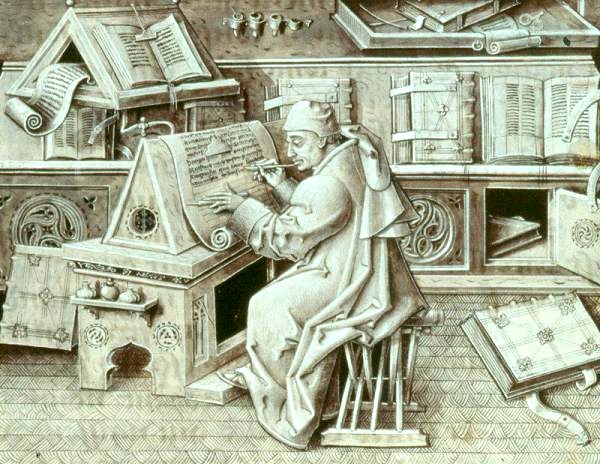
It is for this reason that I name this blog "The Scriptorium." The scriptorium lay at the heart of every monastery, a room where monks labored for long hours, copying and illuminating manuscripts. From copies of the Bible to the poems of Virgil and the philosophic works of Plato and the Master (Aristotle), the heart and soul of Western learning lay in the musty piles of scrolls collected in the monastic scriptoriums. Like the early monks, I too have a passion for learning, and a somewhat extensive library of my own. The purpose of this blog will be to provide reviews of the best books out there, along with some not so great ones for variety's sake. Movies and music will also be considered, although not so often due to my poor background in music theory. If the mood should overcome me, occasional reflections on current or past events may also be posted, along with the occasional poem or two. But the main focus will be on the reviews.

So come, weary traveller, shut out the hustle and noise of the world in the quiet repose of the scriptorium. Fides quaerens intellectum.

Posted on the Memorial of St. Bruno of Cologne , A.D. MMVIII